

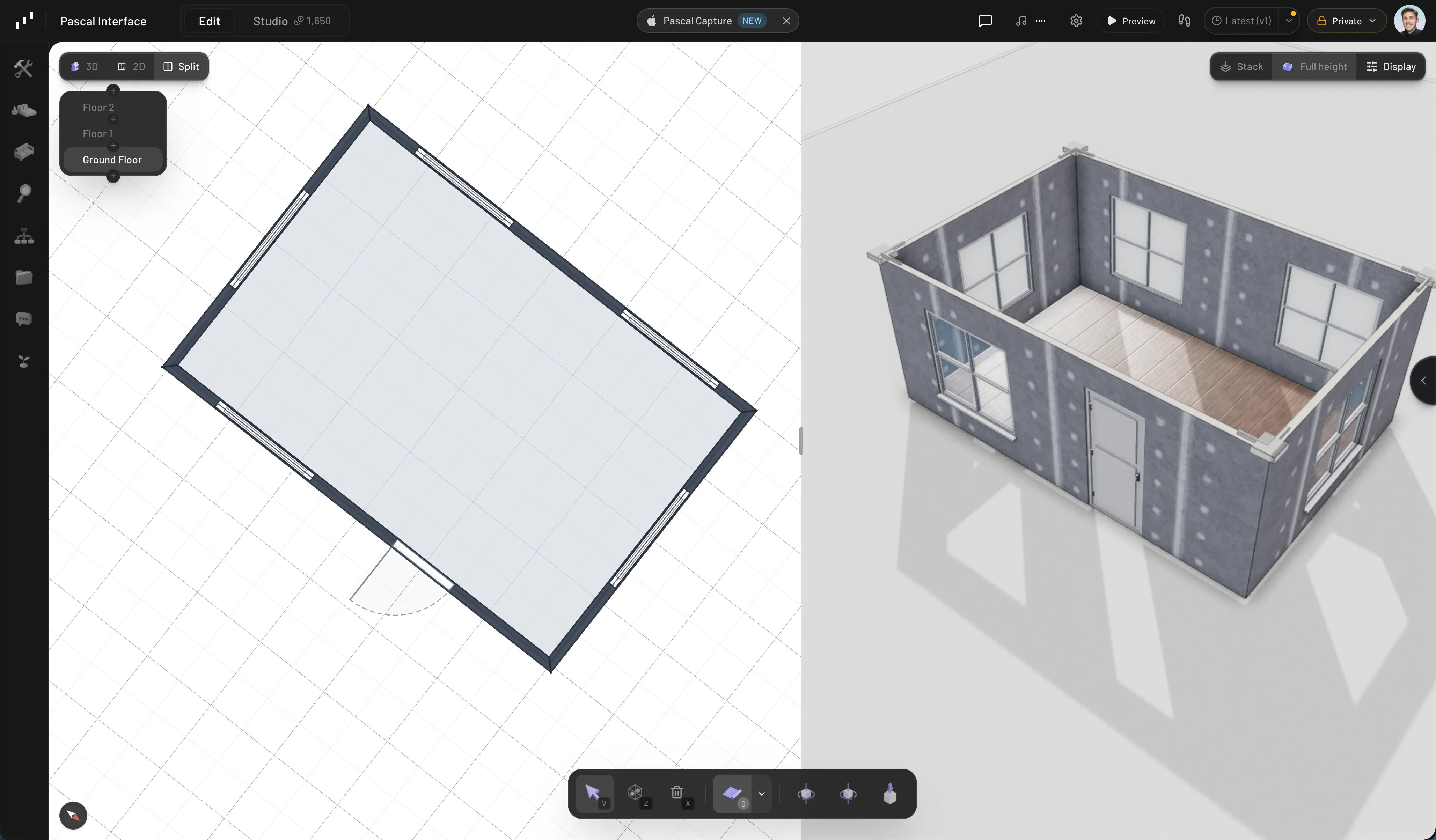
The Pascal editor
Top bar
From left to right:- Pascal logo — click to go back to your projects; hovering opens a project sidebar for quick switching.
- Project title — click it to rename the project inline.
- Edit / Studio toggle — switches the whole workspace between building (Edit) and generating rendered images (Studio). The Studio button shows your credit balance. See Studio renders.
- Feedback — send feedback to the Pascal team.
- Radio Pascal — background music while you build.
- Settings — project settings, including what’s visible to the public.
- Preview — view your scene without editing chrome.
- Walkthrough — enter a first-person walk through your building.
- History — shows the current version; click Save to pin a new version, or open the panel for the version history and what’s published.
- Share — project link access and publishing to the community. See Sharing your work.
- Profile — your account menu.
Left sidebar
An icon rail on the far left switches the sidebar between tabs. Click the active tab’s icon again to collapse the sidebar, and drag its right edge to resize it.- Build — structural elements: Wall, Fence, Slab, Ceiling, Roof, Stairs, Elevator, Door, Window, Column, Spawn Point, plus Painting (materials), MEP (ducts and pipes), and Pre-built rooms. Clicking a tile arms its tool and shows its presets below, filtered by source (All / Pascal / Mine / Community).
- By room — the catalog filtered by room type (kitchen, bedroom, bathroom, …), so you can furnish one room at a time.
- Items — the furniture and object catalog, organized by category. See Finding items.
- Search — search everything in the catalog at once.
- Scene — the scene tree: buildings, levels, and everything on them.
- Files — files attached to the project, such as uploaded scans and guide images.
- Chat — the AI assistant. It opens by default in a fresh session; see AI assistant.
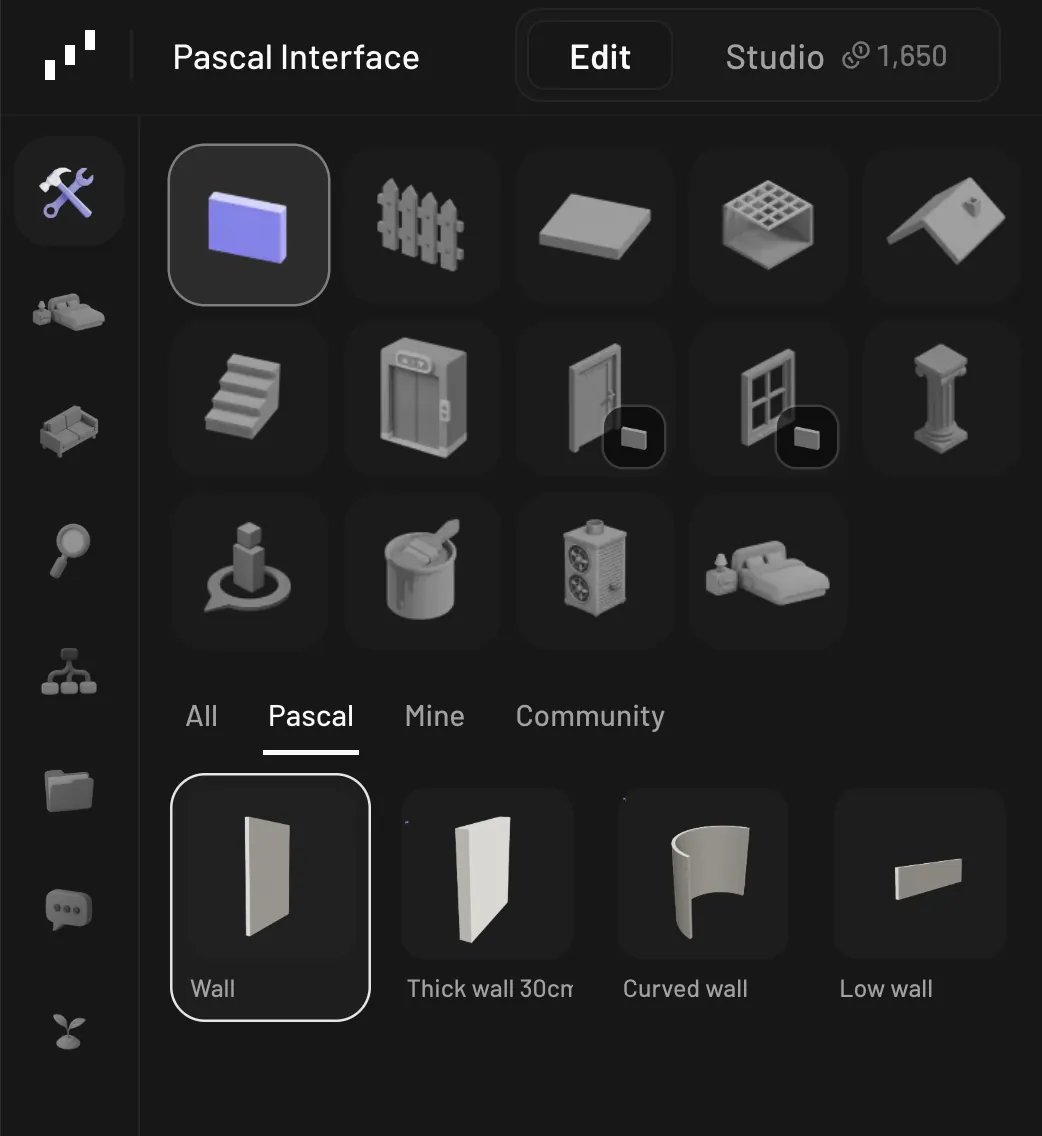
The Build tab in the left sidebar
Views and viewer toolbars
Above the canvas — views. Pick what the canvas shows: 3D, 2D (a flat floor plan of the active level), or a view a plugin adds — the ⋯ menu lists them all and pins the ones you use. Split (or\), at the right of the bar, shows two views side
by side, each pane with its own bar; the swap button trades their sides. Drawing tools
work in 3D and 2D alike.
Top right — display controls.
- Walls — cycles wall height rendering: Cutaway, Full height, Low.
- Display — a menu gathering Shadows (On/Off), Camera (Perspective/Orthographic), Units (Metric/Imperial), Render (Solid/Rendered), Materials (Colored/Monochrome), Edges (Off/Soft/Strong), and scene Theme.
Level selector
A floating panel at the top left of the canvas lists your levels. Click a level to make it active, and use Add level above / Add level below to grow the building. Each level’s menu supports rename, duplicate, and delete, and you can drag levels to reorder them.Cmd/Ctrl + ↑ / Cmd/Ctrl + ↓ switch levels from the keyboard. See
Floors & levels.
Bottom toolbar
Centered at the bottom of the canvas:- Select (
V) — the default mode: click to select, drag to move. - Delete (
X) — click elements to remove them. - References — toggles uploaded scans and guide images on the current level, with per-item opacity, visibility, and upload controls. See Guide images.
- Orbit Left, Orbit Right, Top View — camera buttons.

The bottom toolbar
Inspector and helpers
- Inspector — selecting an element opens a floating panel at the top right of the canvas with its properties (dimensions, options, materials). Drag its header to move it; click the header to collapse it to a title bar.
- Contextual hints — while a tool is active, a hint strip shows the keys that matter right now (snapping mode, rotation, selection modifiers).
- Command palette — press
Cmd/Ctrl + Kto search commands: tools, level actions, view toggles, snapshot, undo/redo, and more.
Undo
Cmd/Ctrl + Z undoes, Cmd/Ctrl + Shift + Z redoes — for building, placing, painting,
and deleting alike. The full list of shortcuts is on the
keyboard shortcuts page.